Structured Content Stack Explained
The Structured Content Stack was one of the last ideas developed for Designing Connected Content back when we were writing it in 2017. As such, it was just a diagram in a chapter of a book. But it has been one of the things I've pulled out most often in the intervening years. It is foundational to understanding the different layers of structured content's creation and use.
Building on the pace layers proposed by Stuart Brand in 1999, in which differently paced layers operate somewhat independently, but which are influenced by and respond to the layers closest to them.
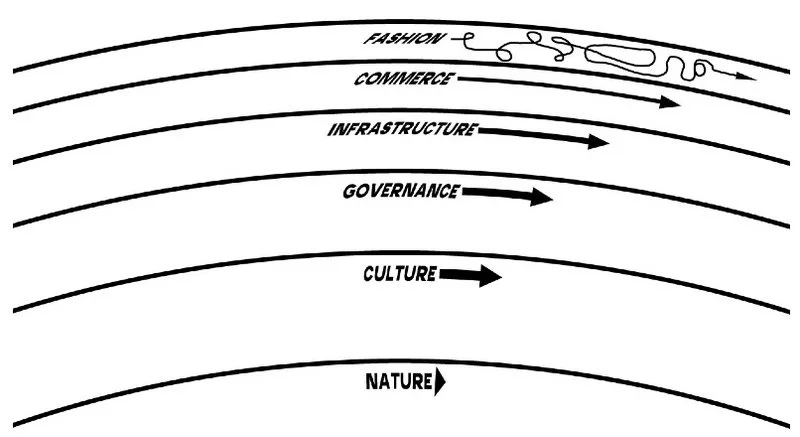
Stuart Brand’s pace layers showing how different aspects of civilization change at different paces.
Brand's layers considered civilization. Others have considered smaller aspects of our world. The Structured Content Stack considers the layers of structured content from its foundation to each interaction with it.
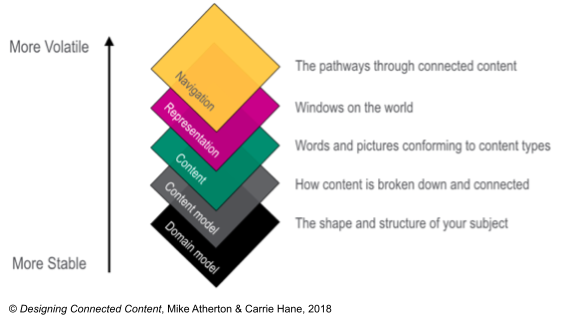
The Structured Content Stack developed in the writing of the book Designing Connected Content.
The five layers in the stack go from the most stable at the bottom to the most volatile at the top.
Starting at the most stable, we have the domain model. You want a stable foundation on which to build, because all these layers above the domain model are likely to shift more often.
Domains are subject areas. They change slowly, only when there are big shifts in how experts view the subject.
The domain model is a map of a subject area in which an organization operates. It consists of connected domain objects that correspond to the real world—and exist whether or not the organization exists. Therefore, the domain model will only change when the domain changes, making it stable.
Take the domain of Live Music. It has been around for centuries. The domain objects in your model would be things like Performer, Performance, Venue, and Ticket, whether it was 1826 or 2026.
The content model is a representation of the types of content an organization has and how they are connected. In this stack, the content model is not a data model of a content management system (CMS) or any sort of repository. It is how an organization wants to show up within the domain. It maps which domain objects become content types, which are reusable containers for storing content that has a common structure and purpose. For a live music venue, content types might include Performer, Event, Venue, and Ticket.
The content model is stable as long as an organization continues to produce the types of content that explain its work, provide useful information to its target audiences, and connect the information so navigation is inherent.
There might be small changes to the model as the layers above it change and require a response. Those changes should be carefully considered and flow through all the layers. Because these layers are inextricably linked, changes to one layer affect another. None are independent.
In the middle is content—meaningful information that is expressed through a medium and created based on the content model. It's the instances of each content type: Taylor Swift, Eras Tour 27 July 2024, Olympiastadion, München. Instead of the downward pressure of a new web page or document dictating the content that an organization creates, it's the other way around. This makes the model a guide for governance and publishing.
Content based on a model is deliberate and consistent. The model informs the types of content needed to fulfill business and audience needs. Instead of a blank page, people start with a defined content type designed to be filled with the content needed for the moment. Review and analysis can be established based on content type so that content remains useful throughout its lifecycle—and removed when it has served its purpose.
That content gets delivered via various representations, or the interactive interfaces where content shows up. Each one is a window into the domain and the organization. The types of representations, what they look like, and who accesses them change rapidly. Just a few years ago, we were thinking primarily of websites as the primary windows into a world. Then social media became its own way to share our ideas and information. Now AI-powered chatbots and agents are fast becoming how people primarily interact with content. Those who created content based on content and domain models back in the 2010s aren't having to do much to make it fit this new representation. Those who embedded content in the representation itself are struggling.
Now we are at the top—navigation. Navigation here isn't menu structures. It is how people move through a space, more of a verb than a noun. Every path a person or machine takes to find their way is the Navigation layer in this stack. Those paths are unique and endless. If you have based it all on a strong foundation, your experience will hold up no matter who or what accesses it and the manner in which it's accessed. In the case of Taylor Swift's tour, someone should be able to find the performance in München on 27 July 2024 no matter how they search or where they start.
There is no longer a way to keep up with every interaction manually. Content must be able to withstand the downward pressure of new navigation modes, and it can when it's built on a strong, stable foundation.